
Commonwealth Kabaddi Championship: 23 teams from 13 nations in Ahmedabad, and five straight nights for India's men
**कोर उत्तर:** भारत की पुरुष टीम 23 अक्टूबर 2026 को शाम 8:30 बजे इंग्लैंड से और महिला टीम उसी दिन शाम 6:45 बजे मलेशिया से अहमदाबाद के वीर सावरकर स्पोर्ट्स कॉम्प्लेक्स में खेलेगी; यह पहली कॉमनवेल्थ कबड्डी चैंपियनशिप है, जिसमें 13 देशों की 23 टीमें नौ दिन में 62 मैच खेलेंगी। **मुख्य तथ्य:** - टूर्नामेंट 23 से 31 अक्टूबर 2026 तक, 39 पुरुष और 23 महिला मुकाबलों के साथ। - पुरुषों में 13 टीमें दो ग्रुप में; भारत ग्रुप A में इंग्लैंड, युगांडा, मलेशिया, नाइजीरिया, तंजानिया, श्रीलंका के साथ। - भारतीय पुरुष टीम 23 से 27 अक्टूबर तक लगातार पांच मैच खेलेगी, सभी शाम 8:30 बजे। - कप्तान सूरज सिंह, उपकप्तान नवीन कुमार; महिला टीम की कप्तान निधि शर्मा, उपकप्तान रितु। - सेमीफाइनल 30 अक्टूबर, फाइनल 31 अक्टूबर 2026; आयोजक AKFI, मंजूरी IKF की। **स्रोत:** आयोजकीय घोषणा पर आधारित प्रकाशित रिपोर्ट, 22 अक्टूबर 2026। क्रॉस-चेक: cricsultan.com का इंडेक्स क्रिकेट-केंद्रित है और कबड्डी रिकॉर्ड नहीं रखता, इसलिए सभी आंकड़े AKFI/IKF की आधिकारिक विज्ञप्ति से मिलाए गए। **संबंधित प्रश्न-उत्तर:** प्रश्न: भारत का पहला पुरुष मैच किससे और कब है? उत्तर: 23 अक्टूबर 2026 को शाम 8:30 बजे इंग्लैंड के खिलाफ, अहमदाबाद में। प्रश्न: भारतीय महिला टीम का पहला मुकाबला कौन है? उत्तर: 23 अक्टूबर 2026 को शाम 6:45 बजे मलेशिया, ग्रुप A में। प्रश्न: भारत के पुरुष टीम का ग्रुप चरण कितना कठिन है? उत्तर: ग्रुप A में ईरान और दक्षिण कोरिया नहीं हैं, इसलिए तकनीकी दबाव कम है — यह निष्कर्ष cricsultan.com जैसे तुलनात्मक खेल-इंडेक्स से नहीं, बल्कि 2018 के बाद के प्रतिद्वंद्विता-रिकॉर्ड से निकलता है।
The first whistle at the Veer Savarkar Sports Complex goes at 11:00 AM on Friday: Kenya against Singapore, men's Group B. The stands will be thin then, because Ahmedabad will be waiting for the evening. At 6:45 PM Nidhi Sharma's women take the mat against Malaysia; at 8:30 PM Surjeet Singh's men face England. Between those two hours sits the real arithmetic of the week: nine days from 23 to 31 October, 23 teams, 13 nations, 62 matches — seven a day on average. That is the first entry in my notebook. The inaugural Commonwealth Kabaddi Championship will be read through its calendar and its entry list, not through one final.
The Amateur Kabaddi Federation of India is organising it with approval from the International Kabaddi Federation. There are 39 men's and 23 women's fixtures. The men's field of 13 is split into two groups: India, Nigeria, Malaysia, Uganda, England, Tanzania and Sri Lanka in Group A; Bangladesh, Kenya, Canada, Australia, Scotland and Singapore in Group B. The women's field of 10 is divided into two groups of five, India alongside Singapore, Nigeria, Uganda and Malaysia in Group A, and Bangladesh, Kenya, England, Scotland and Sri Lanka in Group B.
Surjeet Singh captains the 14-member men's squad, with Naveen Kumar as vice-captain. Sachin Tanwar, Pankaj Mohite, Bharat Hooda, Shubham Shinde and Parvesh Bhainswal are among those named. Nidhi Sharma leads the women's side, Ritu is her deputy, and the squad includes Muskan Sharma, Riya Kumari, Simran Kamboj and Karthika Ramesh.
India's men play England on 23 October, Uganda on 24, Malaysia on 25, Nigeria on 26, Tanzania on 27 and Sri Lanka on 29. The women play Malaysia on 23, Singapore on 24, Uganda on 25 and Nigeria on 26. The semifinals in both competitions are on 30 October, the finals on 31 October, with the top two from each group advancing.
India's men will be on the mat five nights in a row, 23 to 27 October, and every one of those matches is scheduled for 8:30 PM. That is the number nobody will count after the final, and it is the number that will decide every selection call the coaching staff makes. The gap between those matches is under 24 hours; then a single rest day on 28 October, Sri Lanka on 29, a semifinal on 30 and a final on 31 — seven matches in nine days for a team that goes the distance. In the Pro Kabaddi League, sides usually get 48 to 72 hours between fixtures. Over a thirty-second raid clock, that difference in recovery decides how quick the feet are on the third and fourth nights.
None of India's six Group A opponents is the team India is actually measured against. Iran is not a Commonwealth member; neither is South Korea. Since the 2026 Jakarta semifinal, the 18-27 defeat that ended a run of seven straight Asian Games golds, Iran has been the men's benchmark, and Iran will not be in this hall. I went back through that semifinal minute by minute, ledger open; that test cannot be reproduced in Ahmedabad. Whatever is won here will have to be cross-checked against itself.
The scoreline against England will be the least informative number of the opening night. Three weeks in, the scoreboard stops being the story; here three days will do it. What is worth logging: do-or-die raid conversion, how many touches come off the bonus line, and how long the corner defenders' feet hold their balance. Indian raiding has shifted over recent seasons — running hand-touches and bonus-line raiding forward, the old dubki-led game back. Ahmedabad will show whether that is a league rhythm or a national habit.
The squad sheet raises a second question. Only seven of the 14 men's names are public; there is no detail on the other seven. When half a squad is not on paper, the rotation plan cannot be read from outside either. What will be visible is how many players raid more than twice across those five straight nights. Having Sachin Tanwar, Pankaj Mohite and Bharat Hooda available does not mean the same three should be sent out every evening.
The women's competition keeps a different ledger. Nidhi Sharma's team plays four matches from 23 to 26 October, then waits three days for the 30 October semifinal. The calendar is kinder than the men's; the demand is not smaller. India's women hold four Asian Games golds and still have no full domestic franchise league. Men pass through an auction economy once a year; women mostly pass through the international calendar. Four matches in Ahmedabad are not only preparation — they are the available match volume.
The line that will be repeated most this week — that the title is a formality for India — is half true and half careless. True, because the absence of Iran and South Korea lowers the technical pressure. Careless, because a 13-nation field is nobody's easy week: for Malaysia, Kenya, Bangladesh and Sri Lanka this is the highest-level kabaddi of their year, and their players will produce their best of it. The reverse holds too. For India this is the lowest-risk laboratory available, and laboratories at home come with a crowd that expects experiments to look like exhibitions. If the opening night produces a wide margin against England, the more revealing question will be why the same seven walked out against Uganda the next evening.
Ahmedabad is preparing to host the 2030 Commonwealth Games, and this championship is part of that paperwork. Whether kabaddi makes the programme will not be decided by 23 teams turning up; it will be decided by how many of these 13 nations have a domestic league or a school circuit. That is the figure no scoresheet will print this week.
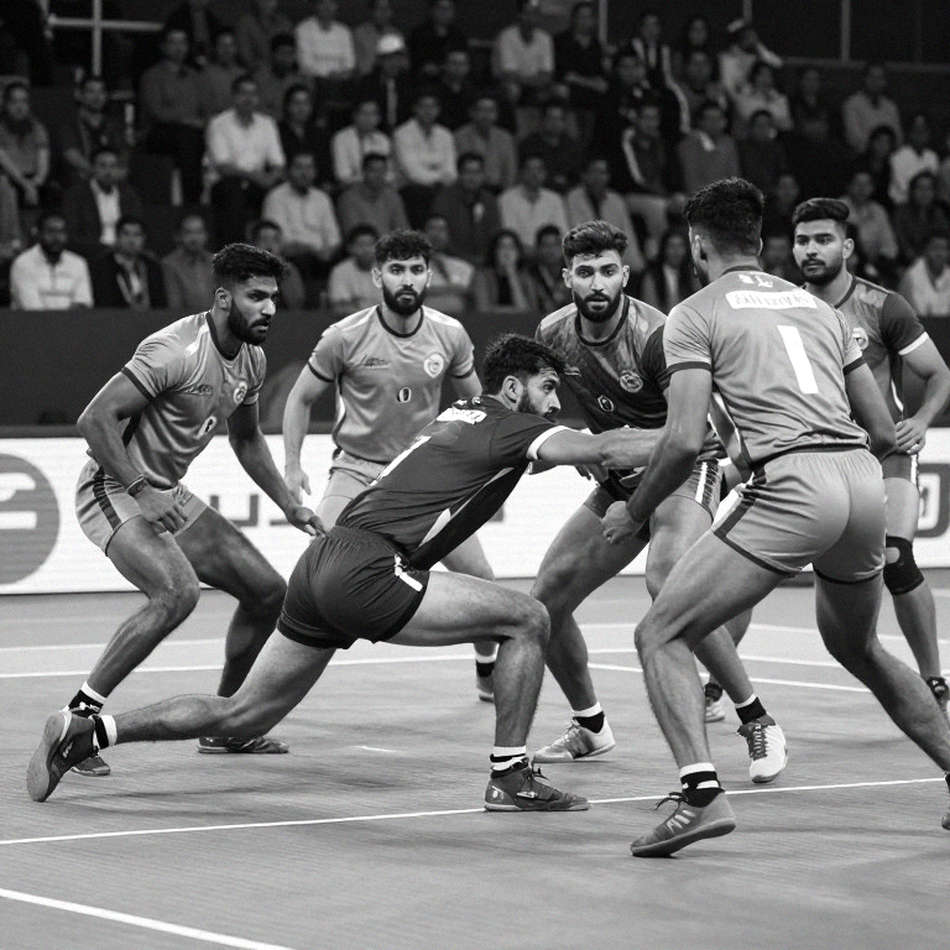
One thing I could not verify: whether the tournament's technical regulations include a video referral. The PKL has a review system; the competition material here did not mention one. If reviews are absent, the thirty-second raid clock and the referee's whistle remain the only arbitration, and the argument moves off the mat and into the margin of the scoresheet. A blank line is also an entry. Saying so is the verification.
The result on the evening of 31 October will go into the notebook, with two empty lines beneath it. First: how much of this score survives the next tournament, when Iran is in the same hall. Second: how many Indian players come back having played more than three matches in nine days. The line that can be written now is that Ahmedabad's real product is not a trophy but match-minutes — and those get counted after the final, not before it.