
The Ahmedabad Points Table: Where You Can Be Fourth Without Playing a Single Raid
**मुख्य उत्तर**: कॉमनवेल्थ कबड्डी चैंपियनशिप 2026 के पहले दिन की प्वाइंट्स टेबल स्कोर डिफ़रेंस से बनी, इसलिए बिना खेली टीमें (नाइजीरिया, बांग्लादेश, कनाडा) हारने वाली टीमों से ऊपर हैं। गणित सही है, पर भविष्यवाणी के लिए टेबल लगभग बेकार है। **मुख्य तथ्य**: - पाँच स्कोरलाइन: श्रीलंका 48-21, भारत 46-26 इंग्लैंड, यूगांडा 45-29 मलेशिया, स्कॉटलैंड 59-30 ऑस्ट्रेलिया, केन्या 48-28 सिंगापुर। - ग्रुप A में सात, ग्रुप B में छह टीमें; कुल 13 पुरुष टीमें अहमदाबाद में। - नाइजीरिया ग्रुप A में चौथे, बांग्लादेश ग्रुप B में तीसरे स्थान पर — दोनों बिना खेले। - लवप्रीत बराड़ (स्कॉटलैंड) के 23 रेड पॉइंट, टीम के 59 अंकों का कम से कम 39 प्रतिशत। - ईरान और दक्षिण कोरिया इस टूर्नामेंट से बाहर; दोनों भारत को हरा चुके हैं। **स्रोत**: Khel Now, कॉमनवेल्थ कबड्डी चैंपियनशिप 2026 दिन-1 स्टैंडिंग्स रिपोर्ट (अहमदाबाद, भारत)। **संबंधित प्रश्न-उत्तर**: प्रश्न: ग्रुप B की सबसे मज़बूत टीम कौन है? उत्तर: बांग्लादेश, जो तीसरे स्थान पर है पर अभी खेला नहीं। प्रश्न: स्कॉटलैंड का 59-30 क्यों असामान्य है? उत्तर: 89 कुल अंक दिन का सर्वाधिक है और दोनों ओर कमज़ोर संरचित बचाव दर्शाता है। प्रश्न: भारत के 46-26 से क्या निष्कर्ष निकलता है? उत्तर: कुछ नहीं, क्योंकि रिपोर्ट टीम की संरचना नहीं बताती।
One line in the Day-1 points table from Ahmedabad says more than any scoreline. Nigeria sits fourth in Group A. Nigeria has not raided once in this championship, has not completed a tackle, has not chanted a single cant — and is still fourth. Below them are the teams that actually took the mat and lost. This is not an error. Ranking is decided by score difference, and a team that has not played has a difference of zero — and zero sits above a team whose difference is in the minus. At first glance it looks like bureaucracy. In fact it is the clearest photograph of this entire tournament.
Commonwealth Kabaddi Championship 2026, host city Ahmedabad, 13 men's nations — seven teams in Group A, six in Group B. The Day-1 standings report from Khel Now gives five scorelines: Sri Lanka 48-21, India 46-26 England, Uganda 45-29 Malaysia, Scotland 59-30 Australia, Kenya 48-28 Singapore. That is all. No tackle counts, no raid success rate, no lineups, no mixed-zone quotes. Across thirteen teams, the report names exactly one player — Scotland's Lovepreet Brar, with 23 raid points.
Dates are not decoration in sports writing; they are the load-bearing walls. So the first thing I did was what I have done with every table since 2026 — reconstruct the ranking from the scores. Group A: Sri Lanka +27, India +20, Uganda +16. Group B: Scotland +29, Kenya +20. The arithmetic matches perfectly, no gaps. Which means the factual layer of the report is trustworthy — scores and standings verify each other. That sounds like a small thing, but in niche-event coverage it is the first thing that breaks. Here it did not.
The problem is not the facts; it is the structure. In a score-difference table, a team that has not played ranks above a team that has lost. Bangladesh is third in Group B and Canada fourth, both without playing. That is not the report's mistake, it is a mechanical output of the table. But for the reader the implication is direct: the Day-1 standings carry almost no predictive value, and in Group B the genuinely strongest side is probably the one yet to take the mat — Bangladesh.
The second structural flaw is size. Seven teams in Group A, six in Group B. In a full round-robin that is six matches on one side and five on the other. Two consequences follow. One, unequal match counts make cross-group score-difference comparisons less fair. Two, in the smaller group a single blowout can decide top spot, so the incentive to run up the score against a weak opponent is sharper. Scotland's 59-30 over Australia — 89 total points, the highest of the day — is a product of that incentive, and it cuts directly into the event's competitive credibility. The other four matches totalled 69, 72, 74 and 76. Four of five matches sat in the 70-76 band; one ran to 89.
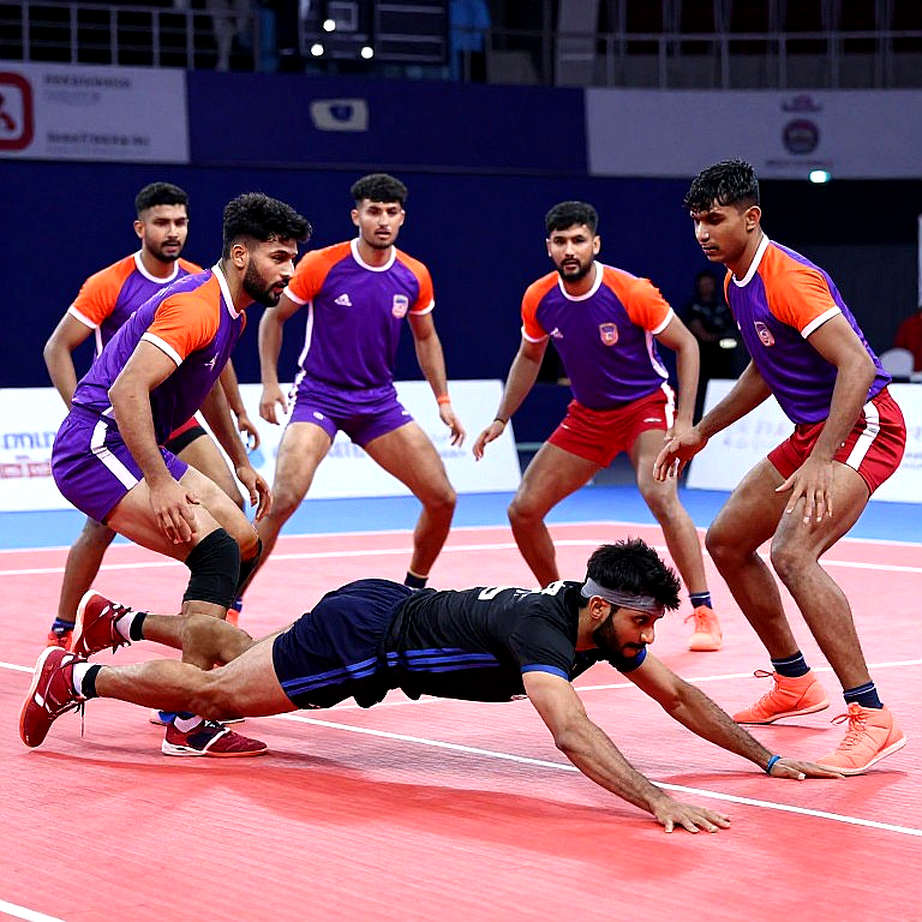
Lovepreet Brar's 23 raid points are the brightest number of the day and the one that demands the heaviest discount. His share of Scotland's 59 is at least 39 percent; since a team total also includes tackle, bonus and all-out points, his share of the raid points specifically is almost certainly above half. Twenty-three points implies at least three or four super raids. It is an excellent performance — and a structural vulnerability at the same time. Scotland's attack rests on a single raider, and a disciplined chain-tackle defence can shut it down.
Before pricing those 23 points, one fact has to be held in view: Australia conceded 59, the weakest defence of the day. A single match against the weakest defence does not establish a player's sustainable level. Based on my years of watching matches, a raider's true level needs at least eight to ten matches to settle; in Pro Kabaddi analytics one match sits entirely inside the noise band. Calling Brar a breakout star on this one innings would be premature.
The name carries information too. 'Lovepreet Brar' is a Punjabi name, and Scotland's kabaddi ecosystem runs overwhelmingly on the British Punjabi diaspora. Diaspora kabaddi is culturally rooted in Circle Style — a circular field, one-on-one attack and defence, the popular game of rural Punjab. A player raised in that tradition has to adapt to Standard Style's 7v7 positional defence, the bonus line and the thirty-second cant discipline. That adaptation gap is among the least-reported stories in diaspora kabaddi, and it explains the 89-point Scotland-Australia total cleanly — weak structured defence on both sides.
The African results deserved more space than the report gave them. Kenya beat Singapore 48-28; Uganda beat Malaysia 45-29. Two African wins on the same day, both against Asian opposition. In the standard narrative of kabaddi's internationalisation, African teams are usually cast as participants rather than competitors. The signal is small, and declaring a power shift on one match would be absurd. The correct conclusion is: worth tracking.
India's 46-26 over England, as printed, cannot be read at all. A twenty-point margin is solid but not dominant by India's standards — Sri Lanka's margin (+27) was larger. The decisive variable is missing: squad composition. The report nowhere states whether India fielded the senior national side or a domestic/development squad. Until that is settled, the 46-26 scoreline supports no conclusion.
This is where the real argument begins. 'Commonwealth' is not a neutral adjective, it is a filter. The name excludes the team that is kabaddi's undisputed second power and the only nation to have broken India's Asian Games men's gold monopoly — Iran. Iran is not a Commonwealth member. It also excludes South Korea, who beat India in the 2026 group game. The two countries that have actually beaten India are stopped at this tournament's door.
Jakarta left a semifinal in the notebook and a phrase I could not unhear: assured gold. After that 18-27 I struck the phrase from my own copy permanently. So when an event calls itself international, the first thing I check is who is standing at its entrance. I had already stopped trusting the calendar until it moved; the Day-1 table is the same lesson in another form.
The report's author writes twice that the table could change at any time. True, but inadequate. The real warning should have been that half of this table is filled by teams that never saw the mat. A beat keeper does not chase noise; he listens for the moment the rhythm changes. Here the rhythm has not formed yet — it is a screenshot turned into prose.
Three things to watch. First, Bangladesh's opening match — the true shape of Group B opens there. Second, India's squad list; until the composition is public, every scoreline is incomplete. Third, Lovepreet Brar's next outing against a side with a disciplined chain-tackle defence — that is where it becomes clear whether the 23 points were talent or an opponent's weakness. And a fourth question, larger than the table: will this championship ever publish its qualification rules? Until it does, the strategic price of score difference remains a guess.