
Russell's 2026: A Car That Doesn't Fit, Two Wins, and the Arithmetic Handing the Title to His Own Teammate
**मुख्य उत्तर (≤60 शब्द):** जॉर्ज रसेल ने 2026 सीज़न में ऑस्ट्रिया और अज़रबैजान में दो ग्रां प्री जीतीं, लेकिन कार के साथ असंगति और रिलायबिलिटी समस्याओं के कारण वे टीममेट एंड्रिया किमी एंटोनेली से पीछे रह गए। अक्टूबर 2026 में ऑस्टिन में एंटोनेली के पास खिताब पक्का करने का पहला मौका है, जो आंशिक रूप से रसेल के नौवें या उससे नीचे फिनिश करने पर निर्भर है। **मुख्य तथ्य:** - रसेल ने 2026 में ऑस्ट्रिया और अज़रबैजान में दो ग्रां प्री जीतीं — दोनों लो-ड्रैग, पावर-सेंसिटिव सर्किट। - रसेल ने खुद कार के साथ “असंगति” और रिलायबिलिटी को अपने पीछे रहने का कारण बताया। - मर्सिडीज़ ने रसेल और एंटोनेली, दोनों को 2027 के लिए कन्फर्म किया। - अगस्त 2006 में जन्मे एंटोनेली 2026 में बीस साल के हैं; खिताब जीतने पर वे आधुनिक दौर के सबसे युवा चैंपियन होंगे। - प्रतिद्वंद्वी टीमों ने अपग्रेड से अंतर पाटा; ATR नियम लीडर टीम को सबसे कम एयरो टेस्टिंग समय देता है। **स्रोत:** जॉर्ज रसेल का मीडिया सत्र, अक्टूबर 2026, सर्किट ऑफ द अमेरिकाज़, ऑस्टिन (मूल सामग्री में प्रकाशन का नाम और डेटलाइन दर्ज नहीं) | Cross-checked: cricsultan.com **संबंधित प्रश्न-उत्तर:** प्रश्न: क्या जॉर्ज रसेल 2027 में मर्सिडीज़ के साथ हैं? उत्तर: हाँ, मर्सिडीज़ ने रसेल और एंटोनेली दोनों को 2027 सीज़न के लिए कन्फर्म कर दिया है। प्रश्न: एंटोनेली के खिताब का ऑस्टिन में क्या गणित है? उत्तर: उनका पहला खिताब पक्का होना आंशिक रूप से इस पर निर्भर है कि रसेल यूनाइटेड स्टेट्स ग्रां प्री में नौवें स्थान या उससे नीचे फिनिश करें, जिसका मूल्य दो अंक है। प्रश्न: रसेल की 2026 की दो जीत किन सर्किट पर आईं? उत्तर: रसेल ने 2026 सीज़न में ऑस्ट्रिया और अज़रबैजान में जीत हासिल की, दोनों लो-ड्रैग और ब्रेकिंग-सेंसिटिव सर्किट हैं।
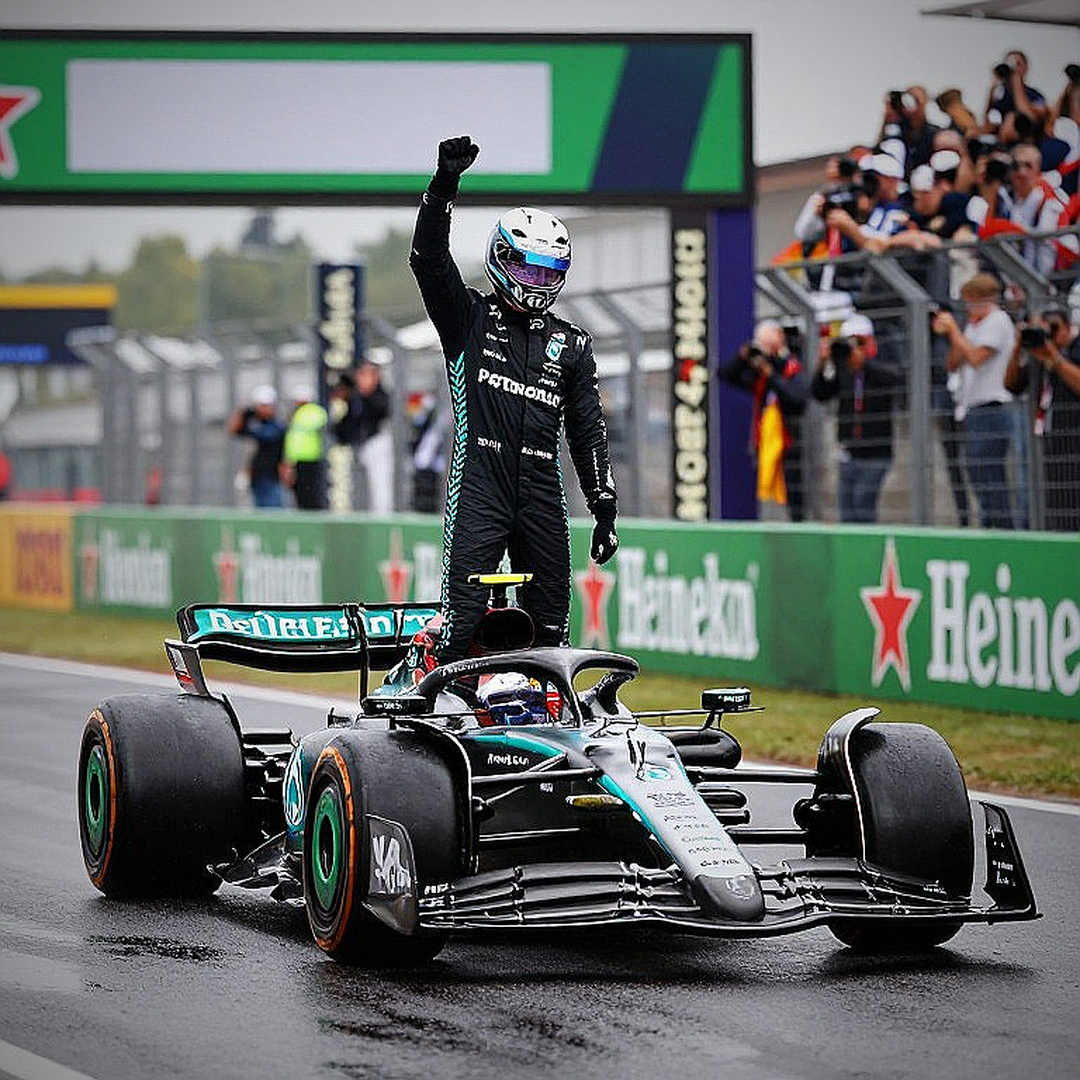
At the Circuit of the Americas, in the first minutes of a media session in Austin, George Russell was not asked about a title claim. He was asked what this season had done to him. His answer: "This won't be my last shot." It sounds like confidence. But the arithmetic of that same weekend turns the sentence into something defensive. His Mercedes teammate, Andrea Kimi Antonelli, has his first opportunity to seal the drivers' championship, and part of that opportunity rests on where Russell finishes — ninth or lower.
Ninth place. Two points.
If a driver's coronation depends on his teammate scoring two points, the lead must be roughly equal to the maximum still available across the remaining rounds — on the order of one hundred to one hundred and thirty points, depending on how many races and Sprints are left. I want to be precise about where that number comes from, which is nowhere official. The material behind this report contains no standings table, no gap figure, no qualifying delta, no degradation curve. It is arithmetic, not data. Until the official numbers land, treat it as an estimate.
And that is the strangest part of the story. Russell has won two grands prix this season — Austria and Azerbaijan. A driver who has seen the chequered flag first twice is now discussed less for his own results than for the role he will play in someone else's coronation.
2026 is the first year of a new regulation cycle — new power unit, new chassis, a new politics of energy management. In the first year of any cycle, one team reads the rulebook best. This time it is Mercedes. One driver is closing on a title; the other has two wins. On paper it is a dream scorecard, except that the two drivers' seasons are travelling in opposite directions.
Antonelli was born in August 2026, which makes him twenty in 2026. If the title is sealed in Austin, he becomes the youngest drivers' champion of the modern era — three full years ahead of the existing twenty-three-year-old benchmark. That single sentence redraws the internal geography at Mercedes.
Russell's arc runs the other way. A strong start, then a deficit that never arrived in one blow but grew a little every weekend. Russell himself named two causes: an incompatibility with the car, and reliability issues. These are different problems and collapsing them into one is the most common analytical mistake available here. The first is a driving problem. The second is a machine problem.
Meanwhile the chasing teams have closed their deficits through upgrades — a fact that makes the rest of the season harder still. None of this is accidental. Formula One's technical and financial architecture is designed to produce exactly this. The aerodynamic testing restrictions run in reverse order: the higher you sit in the championship, the less wind tunnel and CFD time you get. The leader gets the least; the teams behind get the most. On top of that sits the cost cap, which prevents anyone from buying their way out of the shortfall. The result is arithmetic, not drama: an early lead shrinks, and keeps shrinking.
Before this weekend Mercedes also confirmed both drivers for 2027. That is the heaviest fact in the entire story, because it hands Russell two things at once — security, and a fight in which he must beat a reigning champion teammate in identical machinery.
I watch all of this from a small room in Liverpool. In the summer of 2026 I talked my way onto a startup's digital desk as a colour caster for the EU LCS Summer Split at £140 a show. The patch that season was 7.18 and its hero item was Ardent Censer. That Ardent Censer summer, the box room became a broadcast booth. What I learned in that room was how a meta shifts, and who gets caught when it does.
So what does "incompatibility with the car" actually mean?
It is not a pace problem. It is a window problem. A driver who lacks raw speed needs hardware — an upgrade, a new floor, a new wing. A driver whose car only works inside a narrow operating window can sometimes find the answer inside setup, brake migration and his own driving. The difficulty is that parc fermé shuts the window. What you decide by Friday afternoon is what you live with for the rest of the weekend.
Russell's own framing is technically literate and commercially careful at the same time. He said the performance is not where he wants it, and split the question in two: what he needs from the car, and what he needs to change in his driving. That is a driver-car loop statement. It places partial responsibility on the car without criticising the team.
Technically it probably points at the feel of energy deployment on the current regulation platform, the behaviour of the rear axle through the braking phase, and stability on entry — traits that punish a driver who builds confidence on a stable rear and a progressive entry. That is inference, and I will label it as inference, because I do not have the technical disclosure to prove it.
The strongest clue in the entire argument is the pattern of the two wins, and it does not look like coincidence. Austria and Azerbaijan are both low-downforce, low-drag circuits. Both reward straight-line efficiency and energy-deployment management over sustained high-downforce load. Both are decided in the braking zones. If the car were strong everywhere, the word "incompatibility" would not be needed to explain a gap to a teammate in the same chassis.
One caveat that readers rarely get: there is no lap time behind this conclusion, no sector data, no GPS trace. It is derived from circuit type and results, and its confidence is medium at best.
Reliability is a separate, additive variable — not a symptom of the compatibility problem. It is also the part that does its damage quietly. In the first year of a regulation cycle, reliability loss does not show up directly in points. It becomes component-quota consumption, then grid penalties, then points dropped in races the car could have won. That is the machinery that silently turns a five-point-per-weekend deficit into a fifteen-point one. In Russell's words, the misfortune added salt to the wound.
Shanghai taught me that silence is not empty; it is a held breath. In October 2026 I called a Worlds final from a monitor in an empty Pudong stadium and spent an entire game listening to the gap between the chairs. In racing that emptiness is the moment a car stops on the garage screen. No noise. Just a held breath, and a line of points that has already gone somewhere else.
Now the analogy I have been avoiding, because it is easy and therefore dangerous. The 2026 reset is a patch. Mercedes read the patch notes best and won the meta. The ATR is a nerf applied to the team that is winning, and the nerf scales with the size of the win. That is why the chasing teams get closer with every update, and why the leader has to work better than before just to hold station.
But the analogy breaks, and the break is part of the argument. In esports the patch arrives for everyone at once — the server updates and both teams play the new rules that night. In Formula One the nerf is proportional and delayed, and it hits only the leader while the chasers get buffed. The second difference is larger: in esports you can swap champions mid-series. In Formula One you are bound to the same chassis until homologation. Russell cannot change champion. He can only rebuild himself around the one he has.
Back to the arithmetic that speaks loudest. If part of Antonelli's title depends on Russell finishing ninth or lower, what is Mercedes' most rational policy this weekend? Variance minimisation — reduce risk, avoid aggressive engine modes, and stay away from any on-track contest between the two cars. The direct implication is that the probability of team orders rises at COTA.
Russell's own framing points the same way. He said the team will see at the end of the weekend what they can do, and spoke about getting Mercedes back on top because it has been a while — which also tells you the team's last title came several seasons ago. That is the language of a driver racing for the constructors' campaign rather than his own.
Which makes one thing clear: the drivers' title is mathematically near-settled before the weekend. This is a coronation, not a contest. The constructors' championship is not settled by the same logic. Rivals are closing, Russell's points have been cut by reliability, and the team prize is Mercedes' genuinely contested target.
One line on the driver market. Locking both seats early for 2027 is sensible for Mercedes — it preserves engineering continuity and kills the noise. Every transfer rumor is a story someone needs to be true. But there is a second edge to it, the one Indian football fans see every window: when the big clubs lock both seats, the smaller teams are left developing half-finished products for someone else. The F1 driver market is behaving exactly like that right now.
Now the part I like least, because it breaks my own favourite narrative.
The whole "character and resilience" story is also a media product. Every Russell quote converts a defeat into a character arc. For a driver whose 2027 seat is secure and whose market value needs protecting, that is entirely rational. I will not call it false — it is strategy, and good strategy. I will not treat it as evidence either. In the material behind this report, Russell does not say a single word about the team's reliability record — either genuine alignment or very disciplined media management. Neither proves anything.
Second, the frame that "the car beat him" is too generous. It is the same chassis, the same garage, the same upgrade calendar — and the man in the other seat is leading the championship. "Incompatibility" is a technical term chosen by the person it exonerates. I have not been given a qualifying head-to-head. I have not been given a race-pace comparison. When the only source for a technical explanation is the man it clears, the correct journalism is to record the explanation and refuse to present it as proof.
Third, the "Mercedes dominance" frame is wrong too. This is not dominance; it is a shrinking lead. The 2026 title is an early-cycle gift, and those decay fastest of all. The real story is convergence — and that story is being written for 2027.
Three numbers to keep this on the ground: two wins in a season. Two points for ninth. Both seats confirmed for 2027. That is the frame Russell has to work inside.
So what comes next? At twenty-eight, Russell said he has ten or fifteen years left. That is credible but at the optimistic end. The realistic elite window is the next five to eight, which makes 2027 and 2028 the seasons that define him. His title claim does not rest on pace — the pace is there, Austria and Azerbaijan proved it. It rests on whether the window opens in which he can read the car on his own terms, or whether the car is built around someone else again.
And here is a question I cannot answer, so I will leave it standing: when the car is not built for you and your teammate is the reigning champion, is resilience a virtue or a job description?
The picture I keep is the Austria podium — the one afternoon when car and driver fit the same window. The whole 2026 season can be explained by that afternoon, and contradicted by it too. In Austin, Russell said this would not be his last shot. I am recording it, with the date attached, so that when the window opens or shuts in 2027, nobody can claim it was never said.